

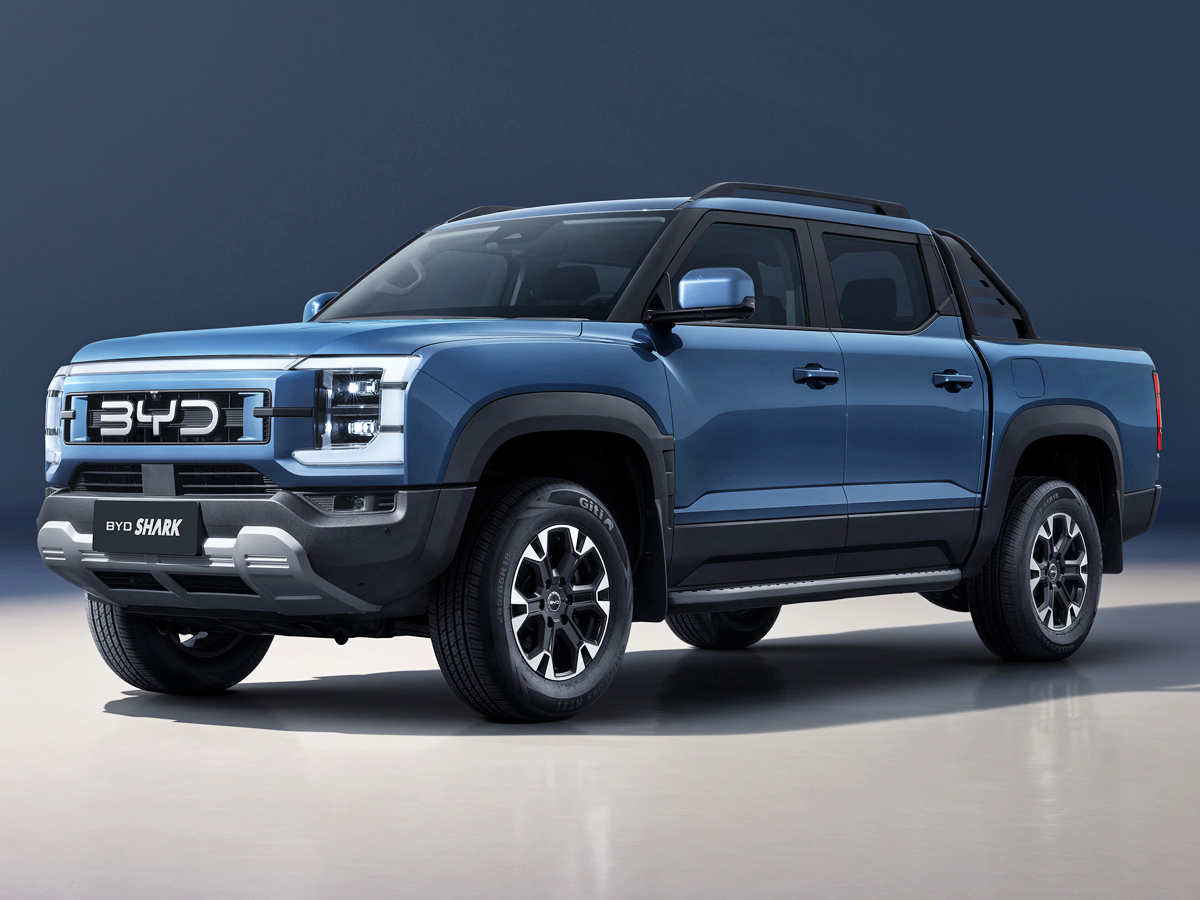






















South Africa’s BYD dealerships just got a new flagship bakkie, and it’s the kind of spec sheet that makes even diesel loyalists pause mid-sentence. Here’s what BYD just dropped into the South African market. If you aren’t aware, the BYD Shark 6 is a highly advanced plug-in hybrid electric (PHEV) pickup truck. It features a 1.5L turbo engine paired with dual electric motors for an impressive combined output of 430 HP and 650 Nm of torque. It delivers an 800 km total driving range and accelerates from 0 to 100 km/h in 5.7 seconds
The new SHARK 6 Performance joins the existing SHARK 6 Premium as BYD’s new flagship bakkie, and it’s not a subtle upgrade. BYD South Africa has expanded its Shark 6 bakkie range with a new Performance derivative, powered by a plug-in hybrid drivetrain comprising a new 2.0-litre four-cylinder petrol engine with increased power of 350kW and 700Nm of torque, a 21kW and 50Nm jump over the Premium model’s 1.5-litre engine.
That combined output, petrol engine plus front and rear electric motors, gets you 0 to 100 km/h in 5.5 seconds, which is genuinely quick for a double-cab pickup. The towing figure is the real headline for anyone who actually uses a bakkie like a bakkie. Maximum braked towing capacity climbs to 3,500kg, up from the Premium’s 2,500kg. That’s caravan, boat, trailer, or heavy equipment territory and it puts BYD squarely in the conversation with the diesel workhorses that have owned this segment forever.
On the electric side, a 29.58 kWh battery delivers up to 80km of electric-only range, and with a full charge plus a full 60-litre tank, BYD claims a combined WLTP range of up to 640km. It also comes loaded with all-wheel drive, 230mm of ground clearance, Crawl Mode for tricky off-road conditions, and Vehicle-to-Load technology that lets you power appliances and equipment straight from outlets in the load bin.
With regards to Pricing: the SHARK 6 Performance starts at R1,149,900, backed by a five-year/100,000km vehicle warranty, a five-year/100,000km maintenance plan, and an eight-year/200,000km battery warranty.
Now you may be wondering why it matters and why it matters here? This isn’t just a car launch. It’s BYD planting a flag in the one vehicle category Africa actually cares about, the bakkie and doing it with plug-in hybrid tech instead of a pure EV gamble.
That’s a smart read of the market. South Africa, Kenya, Nigeria, Ghana bakkies aren’t lifestyle vehicles here; they’re infrastructure. Farmers, mining contractors, energy field teams, construction crews. A pure EV bakkie would die on the first 300km stretch of road without a charger in sight. A plug-in hybrid that can still run on petrol solves the range-anxiety problem that’s kept EVs out of rural and industrial Africa in the first place.
If BYD can prove the SHARK 6 Performance survives real African road and load conditions, not just South African tarmac and dealership demos, it becomes a legitimate contender against the Hilux and Ranger for fleet buyers in the energy and infrastructure sector. That’s a market worth billions across the continent, and right now it’s Toyota and Ford’s to lose.
Let’s be honest about the fine print. An 80km electric-only range sounds good on a spec sheet, but on an actual work site, running a generator, hauling equipment, sitting with the AC on in 35°C heat, that number shrinks fast. This is still, functionally, a petrol bakkie with a battery bolted on for efficiency bragging rights, not a genuine EV.
And at R1.15 million, this isn’t competing on price. That’s Hilux GR-Sport and Ranger Raptor money, in markets where the entry-level Hilux still outsells almost everything else combined because it’s cheaper, simpler, and every mechanic in every small town knows how to fix one. BYD’s tech is impressive; BYD’s service network outside South Africa’s major cities is not.
Without bleeping, I believe BYD isn’t going to dethrone the Hilux in Africa’s bush anytime soon; the service network and price gap are too wide. But this launch is the clearest signal yet that combustion-only bakkies have an expiry date on this continent, and the fleet operators who ignore that now will be paying import premiums to catch up in five years.