






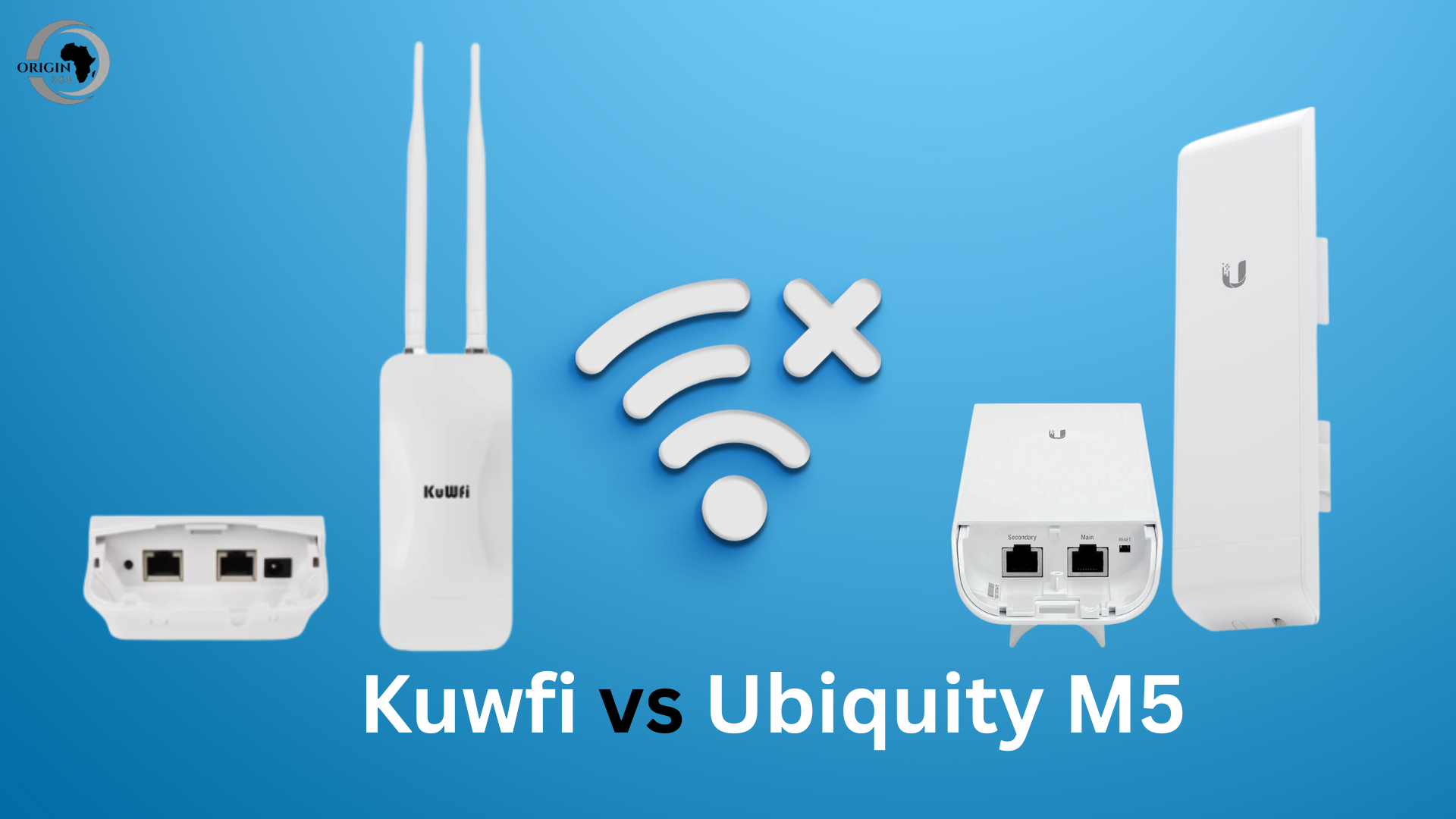















When installing wireless networks for hotels, offices, homes and other client environments, there is rarely a single wireless device that can do everything perfectly. Sometimes the priority is long-distance connectivity. Sometimes it is broad Wi-Fi coverage around a building. Sometimes the challenge is connecting two buildings without running cable. And sometimes, the most important factor is simply how easy the equipment is to configure and deploy.
Over the course of several network installations, I have found myself using two particular categories of outdoor wireless equipment repeatedly: the Ubiquiti NanoStation M5 and KuWFi outdoor wireless access points/CPEs. Both can be used to extend a network wirelessly, and depending on the model and configuration, they can operate as access points, repeaters or wireless bridges. But after deploying both in real environments, I have noticed a significant difference in how they behave.
My most recent experience came during a network installation at Parliamentarian Flat Hotel, where we deployed both devices. The experience reinforced something I have increasingly come to believe: The question is not necessarily which device is better. The better question is: which device is better for the environment you are trying to cover? The brief was simple on paper: give the hotel solid coverage, inside and out. Reception, the pool deck, a few outdoor lounge areas, and the guest floors all needed to talk to the same network without dead zones. So we deployed both NanoStation M5 outside, with KuWFi handling more of the indoor-adjacent spread.
By the end of the install, the pattern was obvious, and it’s a pattern I’ve now seen repeat across enough sites that I’m comfortable calling it a rule, not a fluke. Before I get into detail on each, be mindful there’s something nobody tells you when you’re starting in wireless networking: the spec sheet lies to you about “range” unless you understand signal shape
The NanoStation M5 is built for direction; it is fundamentally a directional wireless device. Unlike a conventional access point that tries to distribute Wi-Fi around itself, the NanoStation is designed to concentrate its wireless energy in a particular direction. Ubiquiti’s specifications list an antenna gain of approximately 14.6–16.1 dBi, with a horizontal beamwidth of about 43° and a much narrower 15° vertical beamwidth.
That explains something I have repeatedly observed during installations. The NanoStation does not behave like a Wi-Fi bulb illuminating everything around it. It behaves more like a flashlight. When correctly positioned, its signal travels strongly in the intended direction, making it particularly useful when you need to connect one location to another or provide coverage across a relatively open outdoor area.
In my own installations, I have observed a fairly narrow, almost linear coverage pattern. Rather than expecting a uniform circle of coverage around the antenna, I think of the NanoStation’s useful coverage as a corridor extending outward from the device. That characteristic becomes a major advantage when the objective is distance.
The NanoStation M5 is particularly attractive for: Connecting two buildings, Point-to-point wireless links, extending a network across compounds, Outdoor links where there is a clear line of sight, Long-distance wireless connectivity, Rural or semi-open environments, Situations where controlled directional coverage is desirable. Ubiquiti designed the M5 around its airMAX 5 GHz platform, rather than as a conventional indoor Wi-Fi access point. The standard NanoStation M5 also has two 10/100 Ethernet ports and is designed for outdoor deployment.
In practical terms, this makes the NanoStation a very interesting tool when the problem is: “How do I get this network over there?” rather than: “How do I cover everyone around this building?”
The KuWFi takes a different Approach to coverage. The KuWFi devices I have used have given me a noticeably different experience. Where the NanoStation feels highly directional, the KuWFi outdoor AP feels much more oriented toward general coverage.
Depending on the particular KuWFi model, the hardware may provide 2.4 GHz, 5 GHz, or both bands. For example, KuWFi’s dual-band outdoor CPE models can provide separate 2.4 GHz and 5 GHz connectivity, with some models supporting AP, repeater and bridge modes. This dual-band capability is one of the things I particularly like about the KuWFi.
A client can potentially connect an older or longer-range device to 2.4 GHz, while newer compatible devices can use 5 GHz for higher throughput and generally less congestion. In a hotel environment, that can be extremely useful. Instead of thinking primarily about connecting point A to point B, you can think about providing wireless access to people and devices spread around an area.
What I observed at Parliamentarian Flat Hotel is where the comparison became particularly interesting. At Parliamentarian Flat Hotel, we deployed both a NanoStation M5 and a KuWFi outdoor wireless access point(Nine M5S and three KuWFi). The two sets of devices were not simply interchangeable. The NanoStation performed better outdoors, particularly where we needed the signal to travel outward over distance.
The KuWFi, on the other hand, proved particularly effective for coverage closer to and around the building. This was probably the clearest practical demonstration I have had of the difference between directional and broader coverage. The NanoStation gave us the feeling of a wireless corridor: strong coverage in the intended direction, with impressive reach. The KuWFi behaved more like a wireless umbrella: less focused on one narrow direction and more useful for providing access around the deployment area.
That does not necessarily mean that one device has a universally greater range than the other. Antenna design, frequency, transmit power, receiver sensitivity, mounting height, interference, obstacles and line of sight all affect real-world range. But it does mean that the shape of the useful coverage can be very different.
Now, the part I have to be straight with you about, because I’m not here to sell you anything. The NanoStation M5, for all its outdoor muscle, is genuinely more fiddly to configure. AirOS is powerful, but it’s built for people who already know what a channel width setting does. If you’re not comfortable with antenna alignment, TDMA settings, and the general Ubiquiti ecosystem, you will burn an afternoon on a device that should have taken twenty minutes.
The KuWFi, by comparison, is close to plug-and-play. Anyone with basic router literacy can get it running fast. Ubiquiti’s own gear is designed to scale into complex networks impressive, but it comes at the cost of friction for the average client-side installer who just wants the thing to work. So don’t let the “professional gear” label fool you into thinking harder-to-configure automatically means better for your job. Sometimes it just means slower.
Why this matters for African deployments is because this isn’t a small distinction on the continent. A huge number of connectivity projects across Africa hotels, estates, campuses, and community WiFi programmes in places like Lagos, Nairobi, Douala, and Kigali are being built by small technical teams, sometimes solo installers, without the luxury of a dedicated RF engineer on standby. Choosing the wrong shape of signal for your site isn’t a cosmetic mistake; it’s the difference between a client who renews your contract and one who calls you back three times a week.
Cost matters here too. The KuWFi’s lower price point and easier setup make it genuinely attractive for smaller operators trying to stretch a limited installation budget across more sites a real factor when you’re pricing jobs in markets where clients are watching every naira, cedi, or CFA franc.
If your job is punching a strong signal across open-distance compounds, farms, estates, and point-to-point links between buildings, the NanoStation M5 wins, no contest, and its configuration curve is worth climbing. But if I had to bet on which of these two devices becomes the default workhorse for small-to-mid African ISPs and installers over the next few years, I’m putting my money on something built more like the KuWFi: cheaper, dual-band, easier to deploy at scale by technicians who don’t have a Ubiquiti certification. Ubiquiti will keep winning the backbone. KuWFi-style gear will keep winning the last mile. Needless to say, if you want coverage of a facility, you will use more NanoStations than you would with KuWFi