


















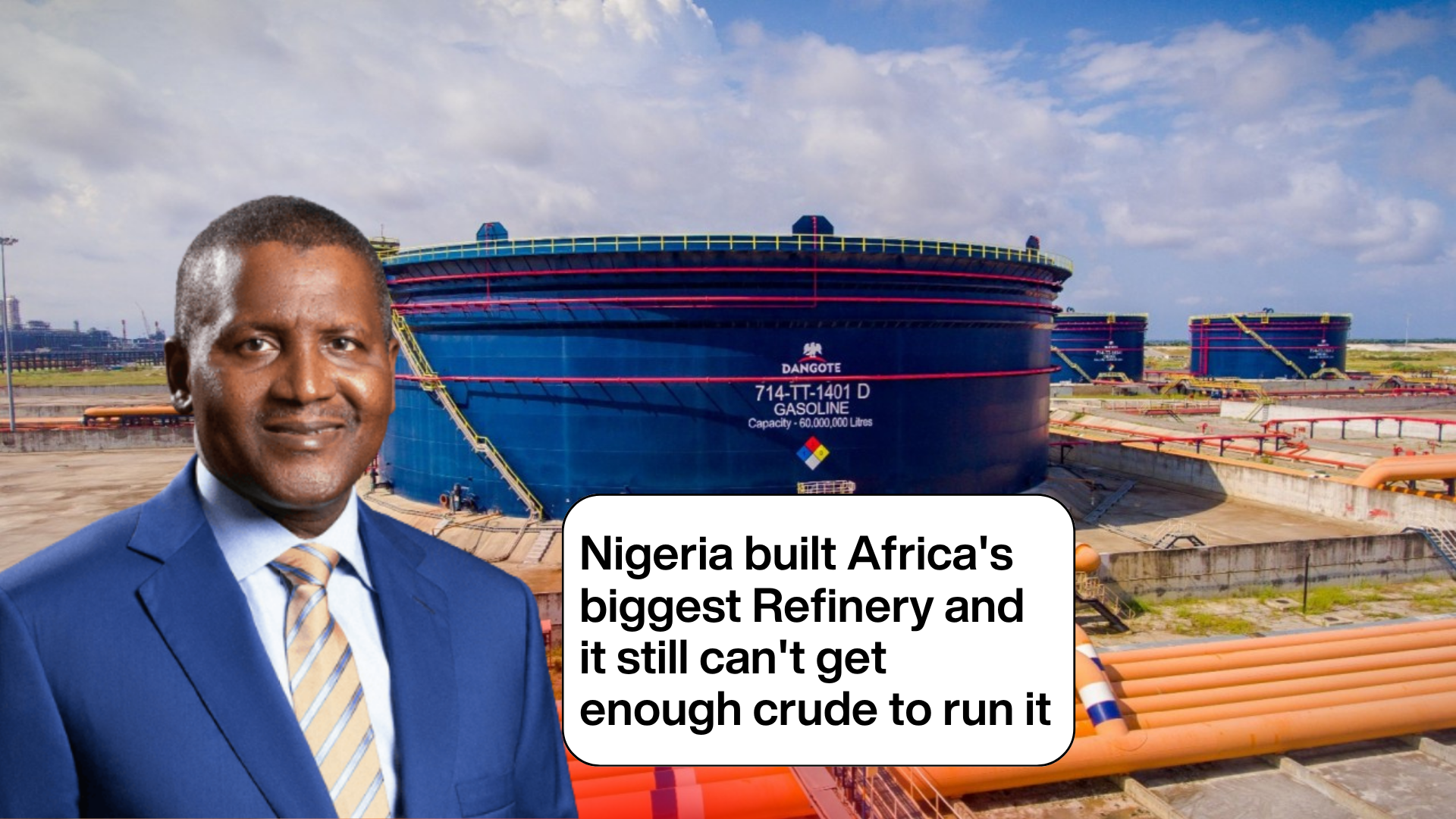






There’s a special kind of irony in owning the biggest oil refinery on the continent and still not getting enough oil. That’s Nigeria’s problem right now, and the government finally seems to be doing something about it.
Nigeria runs on something called the Domestic Crude Supply Obligation, a rule that says local producers have to sell a share of their crude to Nigerian refineries before they’re allowed to export it. Good policy on paper. In the first quarter of 2026, 61.9 million barrels were allocated to domestic refineries, producers offered 68.7 million, and actual supply landed at just 28.5 million barrels. That’s about 46% of what was allocated and 41% of what was offered according to CNBC Africa
That gap is the whole story. The shortfall has fed directly into concerns the Dangote refinery has raised over unreliable domestic crude supply and pricing disagreements, constraining output at Africa’s largest refinery. Now Nigeria is weighing reforms to fix it. The Crude Oil Refinery-owners Association of Nigeria confirmed regulatory discussions this week are evaluating proposals to reduce supply bottlenecks and lower costs. The core complaint is structural, local refiners currently pay an extra $3 to $4 per barrel in feedstock costs because they buy through producers’ trading arms instead of direct channels.
The proposed fixes include allowing direct crude deliveries from nearby production networks straight to local plants, and giving refiners discounts on freight fees baked into Brent-linked pricing when those transport costs were never actually incurred. In plain terms: refiners are being charged shipping fees for oil that never got shipped the way the pricing formula assumes according to news central TV
Why this refinery matters so much is that This isn’t some mid-tier plant. The Dangote refinery is a $20 billion facility outside Lagos with a nameplate capacity of 650,000 barrels a day, the largest single-train refinery on Earth. It’s already reshaped fuel markets: by June 2026, it had overtaken the United States to become Europe’s largest external supplier of aviation fuel.
But there’s a catch that undercuts the “Nigeria is winning” narrative through much of 2025, the refinery was still importing roughly half its crude from the U.S., Brazil, Angola, Ghana and Equatorial Guinea, despite sitting in Africa’s biggest crude-producing country. That’s the paradox in one sentence: a refinery built specifically to end Nigeria’s dependence on imported fuel has had to import crude to stay running, because domestic supply couldn’t be trusted to show up.
Zoom out and this is a governance story, not just an oil story. Nigeria has been trying to build local refining capacity for over two decades. The country currently has nine operational refineries with a combined capacity under one million barrels a day, and the ambition voiced by industry groups like CORAN is to eventually rival global refining hubs like Rotterdam.
That ambition dies quietly if the feedstock pipeline stays broken. It doesn’t matter how much refining capacity you build if crude producers can route around domestic obligations and sell into export markets where the money moves faster and cleaner. Every African country sitting on extraction wealth without matching downstream infrastructure, think Angola, Ghana, Equatorial Guinea is watching this exact tension play out: raw resource abundance doesn’t automatically translate into industrial capacity, because the incentives across the supply chain don’t naturally align themselves.
Where we differ is Reforms being “weighed” and “evaluated” is not the same as reforms being implemented. Nigeria has a long history of announcing supply-side fixes to this exact problem, the DCSO itself was introduced back in 2024 as the fix, and here we are in 2026 still measuring a 46% delivery gap against it.
The freight-fee discount proposal is sensible on its face. But it treats a pricing formula issue as the root cause, when the deeper issue is that producers’ trading arms have every commercial incentive to sell abroad rather than fulfill domestic quotas at a discount. Fixing the freight math doesn’t fix that incentive gap. Until domestic supply obligations carry real enforcement teeth penalties for producers who miss quotas, not just adjusted pricing this cycle repeats.
Nigeria will announce these reforms, and they’ll help marginally. But the country won’t close this gap through pricing tweaks alone. The real fix is enforcement, actual consequences for producers who choose export markets over domestic obligations. Until that happens, expect the Dangote refinery to keep quietly importing foreign crude to hit capacity, while Abuja keeps calling it a domestic success story.