




























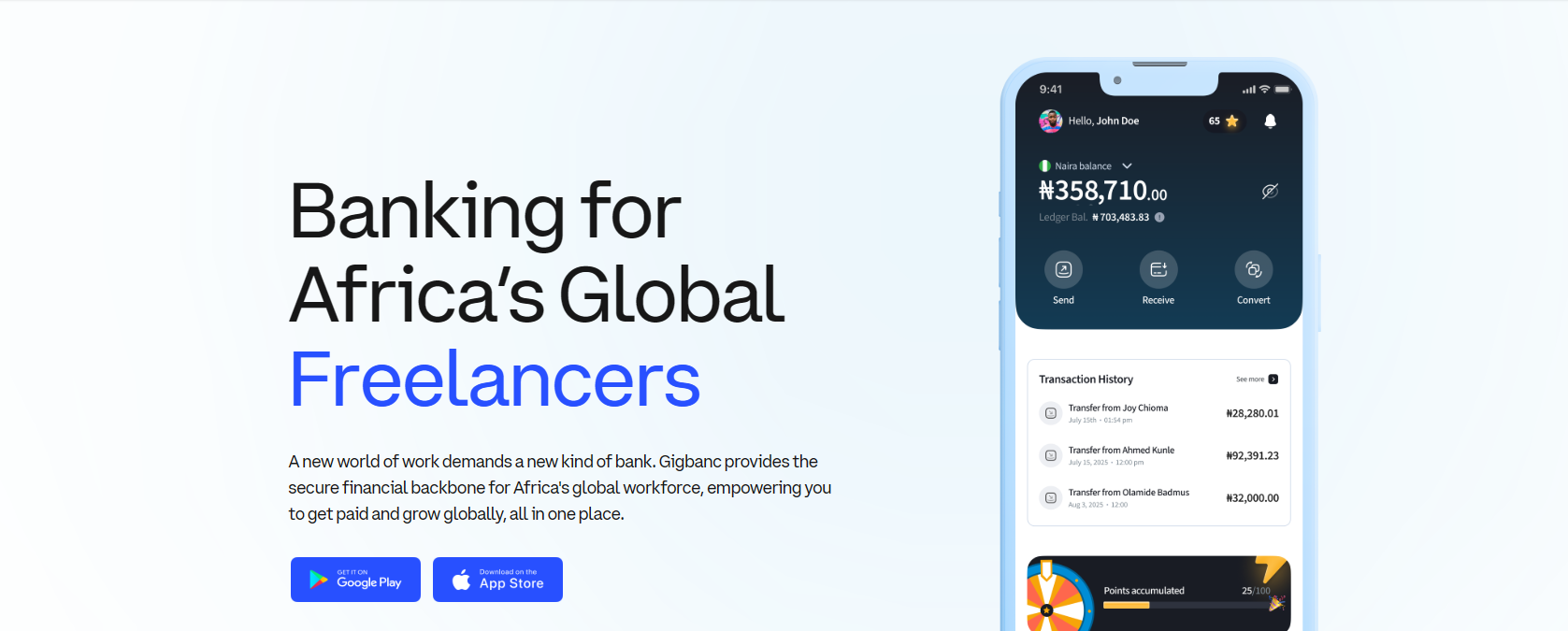
Gigbanc, a Nigerian fintech that built cross-border payment services for freelancers, creators, remote workers and businesses, is shutting down after three years as it struggled to secure fresh funding, and the startup is now in acquisition talks with an undisclosed Nigerian fintech infrastructure provider. Customers have until July 31 to convert their balances into naira and withdraw eligible funds to local bank accounts free of charge. Founded in 2023, Gigbanc targeted Africans earning income from overseas through freelance work, remote jobs and digital businesses, offering multi-currency wallets in naira, US dollars and euros, virtual dollar cards, foreign exchange services, bill payments and transfers to more than 200 Nigerian banks, and the startup says it served more than 150,000 users across over 30 countries while processing more than 10 billion Naira in payments during its lifetime.
Beyond payments, the company also built community programmes for freelancers and remote workers, including the Global Talent Fellowship, GigConnect and GigSocial. On paper, this was a company with real traction, a clear niche, and a founding team with a credible pedigree. Co-founders Paul Okundaye and Babatope Oni brought fintech and consulting backgrounds, with Oni having worked at FairMoney, Trace Apps and Gokada, and Okundaye having worked at Bain & Company and Microsoft. Yet three years in, the company is winding down. What happened between “promising startup with 150,000 users” and “shutting down and hunting for a buyer” is a story every founder chasing venture capital needs to sit with.
News of Gigbanc’s shutdown had blazed across the internet like wildfire, and out of curiosity, I really wanted to know what would make a company so obvious it would be featured among the global 500 in a few years to come, was instead shutting down barely three years after its kick-off. In close talks with a senior colleague, Mr Abdel, who is a business researcher and Analyst, I told him I wanted to put up an article about this, so we shared the discussion for a moment and from his inputs spanning leadership, management, etc., and also my experience with interacting with varying business people from different sectors, it helped me to coin this article
Why it really shut down must be the big question that crossed the minds of everyone who came across the news. Gigbanc’s leadership has been unusually candid about the causes, and their exclamation points to three intertwined failures rather than one clean villain.
Firstly, A funding market that changed the rules mid-game. Okundaye pointed to three reasons for the shutdown: an inability to raise capital, high know-your-customer (KYC) costs, and high infrastructure costs. This wasn’t unique to Gigbanc although African startups raised $1.44 billion in the first half of 2026, the number of disclosed funding rounds fell sharply compared with the same period last year, suggesting that while capital is still available, investors are writing fewer cheques and concentrating on a smaller group of companies, which has made life harder for younger startups that still depend on external funding to grow.
The global fintech picture tells a similar story: total global funding to VC-backed fintech startups did climb 27% in 2025, but deal flow fell 23% in the same period, signalling fewer, larger rounds concentrated on companies with “differentiated ideas, clear execution and bona fide traction.” Gigbanc, still early-stage and without a growth-stage story to tell, sat on the wrong side of that divide.
Secondly, A business model that was structurally expensive to run. This is the part that founders should sit with the longest. Gigbanc said fundraising was only part of the problem. The company also pointed to the cost of running a consumer-focused cross-border payments platform, where KYC requirements, compliance obligations and payment infrastructure all made the business more expensive to operate.
In Okundaye’s own words, “the high KYC and infrastructure costs needed for a B2C cross-border payment product were very challenging.” TechCabal’s reporting frames this plainly: cross-border payments require customer verification, compliance, banking relationships, and payment infrastructure, all of which cost money even before a startup becomes profitable. In other words, Gigbanc chose one of the most capital-intensive categories in fintech consumer cross-border payments and needed continuous external funding just to keep the lights on, long before it could prove it could stand on its own revenue.
Thirdly, A pivot that came too late and cost too much. Gigbanc considered changing its business model but said it could not raise enough funding to support the transition, and “management felt selling the company was the best option,” Okundaye said. This is the classic trap: the company recognised its model wasn’t sustainable, but by the time it decided to pivot, it no longer had the war chest or investor goodwill to fund the shift. A pivot is itself a capital-intensive exercise, and Gigbanc found itself needing money to escape a money problem.
Gigbanc isn’t an isolated case, either. Earlier this year, Nigerian fintech Chimoney shut down after failing to raise additional funding, while cloud kitchen startup FoodCourt paused operations after struggling to sustain its business. Businessday’s analysis of the closure noted that for Nigeria’s tech ecosystem, Gigbanc’s shutdown highlights the changing realities of startup building, where access to capital is no longer sufficient on its own, as investors now demand clear revenue models, operational efficiency, and sustainable growth. That single line is arguably the most important takeaway in this entire story.
What could have been done differently?
It’s easy to say “raise more money” after the fact. The more useful exercise this piece is built for is to look at the systems, leadership decisions, and structural choices that, if made earlier, might have changed Gigbanc’s trajectory.
Unit economics before scale. A B2C cross-border payments platform with heavy KYC and compliance overhead needed a cost structure that could survive slower fundraising cycles from day one, not a structure that assumed continuous capital injections. Founders in regulated, infrastructure-heavy categories should stress-test their model against an 18–24 month funding drought before scaling user acquisition, not after. If the unit economics don’t work without the next round, the business isn’t ready to scale; it’s ready to break.
Diversify revenue away from a single capital-hungry segment. Gigbanc leaned heavily into consumer-facing cross-border payments, one of the costliest fintech categories to run because of KYC and compliance load. A B2B or B2B2C layer selling infrastructure or compliance tooling to other businesses, rather than absorbing that cost per individual user, often carries better margins and less regulatory exposure per transaction. Companies like OneLiquidity have shown that shifting from compliance-as-a-service toward leaner, infrastructure-focused offerings can reduce the exact cost burden that sank Gigbanc.
Pivot earlier, while there’s still a cushion. The decision to pivot should not wait until the runway is nearly gone. Leadership teams need a pre-defined trigger, a specific runway threshold, and a specific growth or margin target that forces a pivot conversation before the company is financially cornered. Waiting until a pivot is the only option left means it will also be the most expensive and least fundable option left.
Treat compliance and infrastructure cost as a product design problem, not a back-office expense. KYC and compliance costs are often treated as fixed regulatory overhead, but they are frequently a design choice which markets you serve, which currencies you support, how deep your verification flow goes, and which banking partners you build on all affect this cost. Building lean compliance architecture (partnering with existing licensed infrastructure providers instead of building from scratch) can meaningfully reduce the capital intensity of a fintech’s core operations.
Build board and investor relationships that transcend one funding cycle. A company that has to sell because it “could not raise enough funding to support the transition” is, in part, signalling that its investor base wasn’t positioned or convinced to bridge it through a strategic pivot. Founders should be cultivating investor relationships and communicating pivot rationale well before the cash crunch, so that a bridge round or extension is a live option rather than a last resort.
Plan the exit as carefully as the launch. To its credit, Gigbanc’s wind-down has been handled responsibly. Users have until July 31 to convert their balances to naira and transfer funds to local bank accounts, and the company disclosed it is in talks to be acquired by an unnamed Nigerian fintech infrastructure company. This matters. How a company shuts down shapes the founder’s reputation, customer trust, and the ability to build again. Every founder should treat an orderly, transparent wind-down plan as a core piece of company strategy, not an afterthought reserved for when things go wrong.
As an Entrepreneur also building something, the biggest lesson here is that despite Gigbanc’s closure, fintech remains Africa’s largest-funded startup sector, but the industry has also experienced some of the highest rates of restructuring and business closures since the global venture capital market tightened in 2022. That tension, the biggest sector for capital, and also one of the most capital-intensive to actually operate, is the real story here. Venture funding was never meant to be a permanent life-support system; it’s meant to buy time to build a business that no longer needs it. Gigbanc raised capital, built real traction, and served a genuine need in Africa’s freelance economy, and it still ran out of runway because its underlying cost structure never became self-sustaining fast enough to survive a tighter funding market.
For founders building today, especially in fintech, and especially anywhere compliance and infrastructure costs sit between you and your customer, the lesson isn’t “raise more.” It’s “design for the drought.” Build the unit economics, the revenue diversity, and the pivot triggers, assuming the next round might not come. When it does come, you’ll be building from strength. When it doesn’t, you’ll still be standing.