

























For most of Africa’s history with large-scale renewable energy, the formula has been the same: the government negotiates a long-term power purchase agreement, an international development finance institution provides concessional debt, a foreign developer builds the plant, and the national utility buys the power at a fixed rate for 20 years. It works, but it is slow, dependent on government capacity and creditworthiness, and ultimately limited by how many PPAs a country’s public sector can negotiate and guarantee at any given time.
Botswana just broke that formula. And the implications stretch far beyond one landlocked Southern African country.
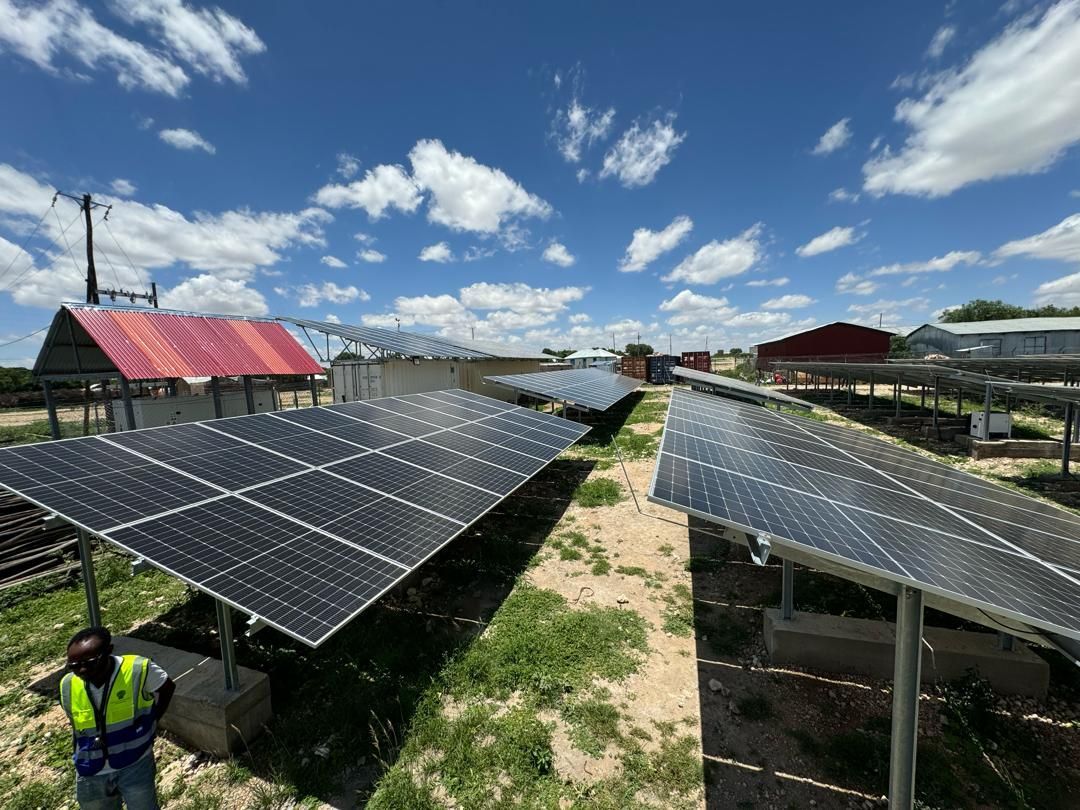
On June 17, 2026, construction officially commenced on the Tati Solar Project, a 100-megawatt solar photovoltaic plant located near Francistown in Botswana’s North-East District. The project represents an investment of over one billion Botswana Pula, secured entirely through commercial financing with Rand Merchant Bank acting as lead arranger. There is no government-backed offtake agreement propping it up. The energy generated will be sold directly through the competitive markets of the Southern African Power Pool and via bilateral agreements with other offtakers a pure merchant model, on a continent where that has rarely been done at this scale. This is not just Botswana’s milestone. It is Africa’s.
Shumba Energy has issued a full notice to proceed to the appointed contractor, with site mobilisation already underway at the site near Francistown in the country’s North-East District. Tati Solar is a 100 MW solar photovoltaic project situated on approximately 160 hectares of land. The project company, Tati Solar (Pty) Limited, is owned 51% by Etavi Renewables, the project’s co-sponsor and developer and 49% by its co-sponsor and equity partner. Shumba holds a 75% interest in Etavi Renewables through its wholly owned subsidiary, Asase Investments.
The project targets commercial operation by 2027, meaning Botswana, which has been heavily reliant on imported electricity and coal-based generation for decades, will within roughly 18 months have a fully operational, domestically owned, utility-scale solar plant feeding power into a regional market serving hundreds of millions of people. The project is expected to create approximately 600 jobs during the construction phase, in addition to sustaining permanent roles once the plant is operational, with a strong focus on local employment and skills development. For the North-East District of Botswana, a region that has historically been economically marginalised relative to the capital, the employment impact is significant and immediate, according to Bloomberg.
The technical specifications of a 100 MW solar plant are, by 2026, relatively unremarkable. What makes Tati Solar genuinely significant is the financing architecture behind it. Rand Merchant Bank arranged and underwrote the entire financing package. As Siyanda Mflathelwa, RMB’s head of infrastructure sector solutions, explained: “We found a financing structure that is commercially viable at utility scale for a pure market view into the SAPP, and that’s great, because it increases the volumes that are now traded on the SAPP day-ahead market.”
To appreciate why this matters, consider what “pure market view” means in this context. Most utility-scale renewable energy projects in Africa are built on the foundation of a long-term Power Purchase Agreement, typically a 20-year contract where a government entity or national utility commits to buying the power at a fixed price. That contract is what gives commercial lenders the confidence to finance the project. Without it, the revenue stream is uncertain, and most commercial banks walk away
Tati Solar is being financed without that guarantee. The developers and their bank took a view that demand on the Southern African Power Pool is sufficiently strong, consistent, and growing that the project can sell its power competitively into the market and still generate returns that justify the capital investment. That is a fundamentally different and far more scalable model.
Mflathelwa put it plainly: “We’re starting to see investors taking a view that there is sufficient demand that justifies the investments in the capital expenditure.” When a major commercial bank says that out loud about African renewable energy, it signals a market maturation that project developers and policymakers across the continent have been waiting years for.
Central to this story is an institution that most people outside the energy sector have never heard of: the Southern African Power Pool. The SAPP serves 12 countries and over 360 million people and businesses across Southern Africa, offering a rapidly growing market due to population growth, improved grid access, and the decommissioning of carbon-intensive generation facilities. It was established in 1995 as a regional electricity market allowing utilities and independent producers to buy and sell power across borders, functioning, in essence, as a stock exchange for electricity across Southern Africa. Africa-energy.
For the Tati Solar Project, the SAPP is the customer. Instead of selling power to the Botswana Power Corporation under a fixed PPA, Tati Solar will sell electricity directly into the SAPP’s day-ahead market competing on price with other generators across the region, earning market-rate revenues rather than a predetermined tariff.
Southern Africa currently faces a deficit of 4,200 megawatts, even as countries such as South Africa and Mozambique have excess capacity. That paradox a region simultaneously short of power and sitting on surplus generation is fundamentally an infrastructure and integration problem. Transmission constraints, grid interconnection gaps, and the slow development of cross-border trading infrastructure mean power often cannot reach the places that need it most.
The SAPP is the mechanism that solves this. And projects like Tati Solar, commercially financed, market-oriented, feeding directly into the regional trading platform, are exactly the kind of generation assets the SAPP needs more of. RMB sees further scope for the SAPP to expand through integration with South Africa’s Wholesale Electricity Market, a platform created after record blackouts prompted South Africa to allow private companies to build power plants of any size and sell electricity into the grid. Linking the platforms would improve price discovery and help direct surplus electricity across southern Africa. Bse
The Tati Solar announcement does not exist in isolation. It arrives at a moment when Africa’s utility-scale solar sector is experiencing structural acceleration. Approximately 970 MW of new utility-scale capacity was commissioned across Africa during Q1 2026, alone the highest quarterly addition on record, surpassing total installations achieved throughout all of 2025. Total installed solar capacity across all segments on the continent has now reached 26.15 GW, with a development pipeline standing at around 133 GW. According to Blackridge Research.
That last number, 133 GW in the pipeline, is the headline that deserves more attention. It represents an enormous volume of projects in various stages of development, many of which face the same fundamental constraint that Tati Solar just helped to crack: how do you finance utility-scale renewable energy in African markets where government offtake agreements are limited, slow, and often uncertain?
Blended and concessional finance structures are being deployed to de-risk early-stage development, with support from institutions such as the International Energy Agency and the African Development Bank. Market-based approaches are emerging, including aggregator and trading models that allow developers to sell power through regional platforms such as the Southern African Power Pool. Tati Solar represents the mature expression of that market-based approach not a pilot, not a blended finance experiment, but a fully commercial transaction at utility scale. It is the proof of concept that the pipeline needs to convert projects from paper to construction.
Why This Matters for the Rest of Africa Including Cameroon
The lessons from Botswana’s Tati Solar Project are transferable across the continent, but several deserve specific attention for Central and West African readers. Commercial financing follows demonstrated demand. One of the persistent challenges for renewable energy developers in Africa has been the reluctance of commercial banks to finance projects without government-backed offtake agreements. Tati Solar demonstrates that where regional demand is clearly established, and a credible trading platform exists, commercial lenders can and will take a market view. The implication for West Africa, where the West African Power Pool (WAPP) serves a comparable regional function, is direct.
Regional integration is not optional. The SAPP’s ability to function as a credible market for Tati Solar’s power depends on years of investment in regional grid interconnection and market rules. The WAPP serves Cameroon, Nigeria, Ghana, Côte d’Ivoire, and their neighbours. The depth and liquidity of that market will determine whether similar merchant financing structures become available in West Africa. Investment in regional grid infrastructure is investment in future bankability.
Local ownership structures matter. Shumba Energy is listed on the Botswana Stock Exchange, and the project structure includes local equity participation alongside international partners. The project is not simply foreign capital building infrastructure on African soil it is African capital, in partnership with regional financiers, building sovereign energy capacity. That ownership structure has long-term implications for reinvestment, skills transfer, and national energy security that a purely foreign-owned project does not.
The 600-job construction phase is the visible tip of a much larger economic iceberg. Direct construction employment is the number that gets cited in press releases. But a 100 MW solar plant, once operational, also requires long-term operations and maintenance capacity, supply chain development, technical training, grid infrastructure, and financial services. The project’s strong focus on local employment and skills development suggests awareness that the economic multiplier effect extends well beyond the plant boundary.
For solar installers and energy companies operating in Africa: projects like this validate the sector in ways that matter to clients, investors, and partners. Every utility-scale project that reaches financial close on commercial terms strengthens the credibility of the entire African solar ecosystem from the 100 MW merchant plant in Botswana to the residential and commercial installations being deployed across Cameroon, Nigeria, and the rest of the continent.
There is a version of Africa’s energy future in which the continent remains perpetually dependent on external financing, foreign technology, and government-guaranteed offtake structures to develop its renewable resources. That model works slowly, but it cannot scale to meet the pace of demand growth across a continent of 1.5 billion people.
There is another version, the one Botswana’s Tati Solar Project points toward, in which African developers, African financiers, and African market institutions combine to build commercially viable, regionally integrated energy infrastructure at a pace that matches the continent’s ambition. Etavi Renewables describes itself as a proudly local independent renewable energy developer committed to delivering reliable, clean and affordable electricity to Southern Africa to address a massive and growing shortage of energy. That language proudly local, addressing regional shortage captures something important about what this moment represents.
Africa does not lack sunlight. It does not lack demand. What it has historically lacked is the combination of institutional capacity, commercial confidence, and enabling infrastructure to convert abundant resources into bankable projects at scale. The Tati Solar Project is evidence that combination is now achievable. The blueprint exists. The question is how quickly the rest of the continent builds on it.