














The global crude oil market is going through one of its most dramatic rollercoaster rides in recorded history. Prices spiked to near $150 a barrel when the Strait of Hormuz effectively shut down after the US-Iran conflict in February 2026, then came crashing back toward $82 by mid-June as ceasefire talks gathered pace. For Africa’s oil-producing nations, such as Nigeria, Angola, Cameroon, Gabon, Congo, this wild swing is both a revenue whiplash and a long-overdue mirror. Because while the world scrambled for barrels, most of Africa sat there holding crude it couldn’t fully refine, watching prices go up and down, and still somehow struggling to benefit from either.
Let me paint you a picture. Your neighbour has a mango tree in their compound. Mangoes fall every season ripe, beautiful, and abundant. But instead of making juice, jam, or even just eating the mangoes, your neighbour scoops them all into crates and ships them to a factory three countries away. Then, when they’re thirsty, they walk to that same distant factory to buy mango juice. At a premium. In foreign currency. That your neighbour, permit me to say, is Africa. And the mango is crude oil. The first half of 2026 has been an extraordinary case study in just how exposed and structurally unprepared the continent remains when global oil markets move in either direction.
Let’s dash back to February 28, 2026, when the United States and Israel launched joint air strikes on Iran. Within days, the Strait of Hormuz, the narrow chokepoint through which roughly 20 million barrels of oil flow daily, was effectively closed. Gulf countries cut total oil production by at least 10 million barrels per day, creating what the IEA described as the largest supply disruption in the history of the global oil market.
Crude prices went vertical. Physical crude oil prices surged to record levels near $150 per barrel, with middle distillate prices in Singapore reaching all-time highs above $290 per barrel. The world was in panic mode. Refineries in Asia slashed runs. Airlines cancelled flights. LPG supplies plunged.
And Africa? Well, Africa watched its pump prices explode, too. In Nigeria, despite being an oil producer, petrol prices surged sharply. According to Africannews, one tricycle rider told reporters his small container of fuel went from ₦200 to ₦600 in a matter of days. A man sitting on top of crude oil reserves, paying three times more for refined fuel. If that doesn’t summarise Africa’s energy paradox in one sentence, I don’t know what does.
Then came the ceasefire talks. By May, the Brent crude oil spot price had fallen to an average of $107 per barrel $10 lower than April, the first monthly decline since December 2025, as reports surfaced that the US and Iran were nearing an agreement to reopen the Strait of Hormuz according to U.S. Energy Information Administration By mid-June, North Sea Dated crude prices had collapsed by more than $40 per barrel to around $82, as oil demand faltered and speculation built that a US-Iran peace deal was close.
So within four months: $60 up, $40 back down. If you’re an African oil-producing government that wrote a budget assuming $70 oil, congratulations, you’ve been on a financial rollercoaster you didn’t design, don’t control, and aren’t equipped to manage.
The IEA had already warned that the first quarter of 2026 could see one of the largest oversupplies in recent years, with inventories potentially rising by up to 5 million barrels per day, a level that would put additional pressure on prices. That was before the Hormuz crisis even started. The underlying fragility was already baked in.
.Coming to Nigeria, One Man, One Refinery, and a $20 Billion Told-You-So. Here’s where the story gets interesting and, honestly, a little embarrassing for the Nigerian government. Nigeria has three state-owned refineries. None of them is operational. The government spent $18 billion on their maintenance over the past two decades. Let that number settle. $18 billion. In maintenance. On refineries that don’t refine. If you gave me $18 billion to maintain something and it still didn’t work, I would be ashamed to show up to budget meetings.
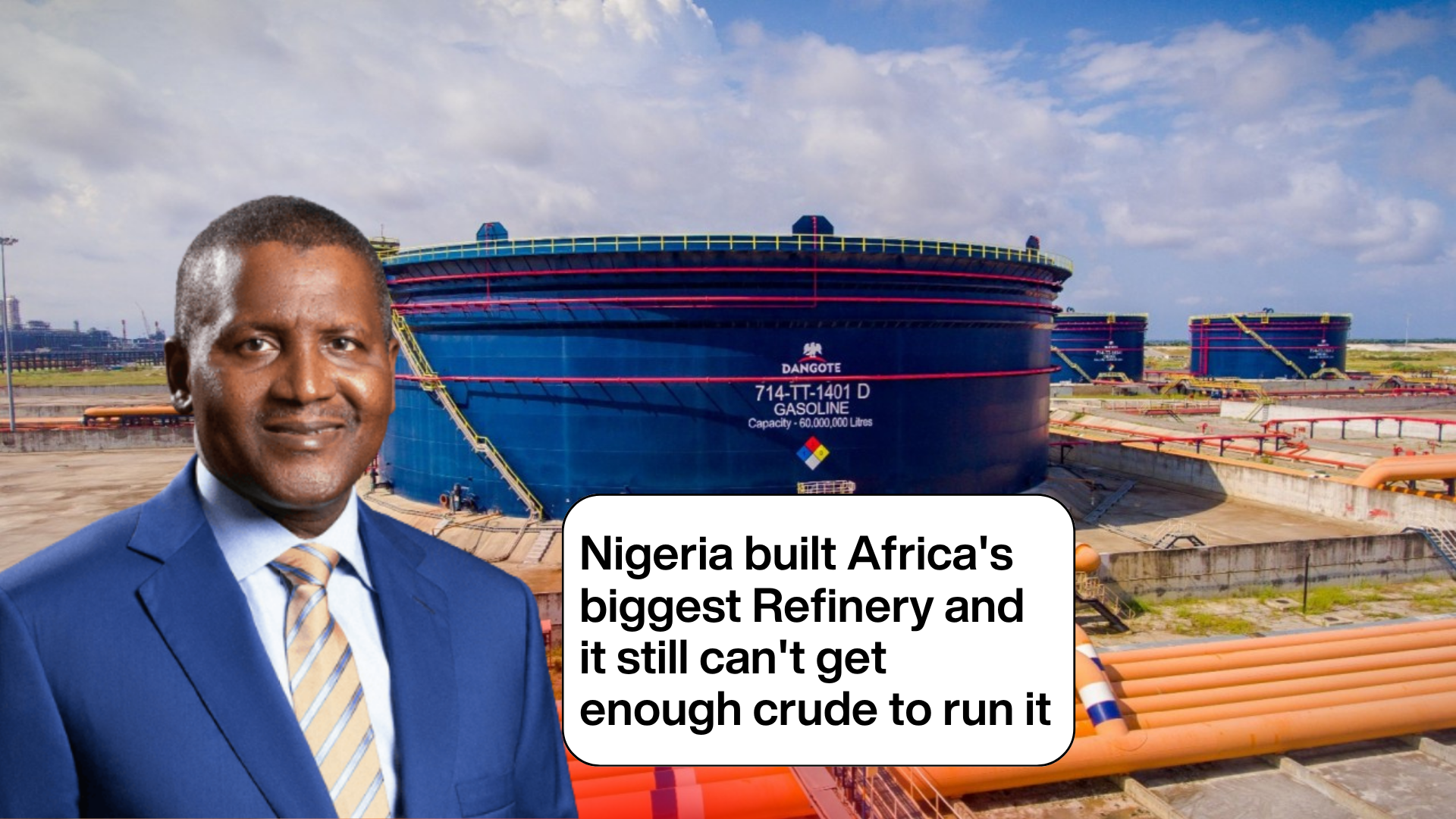
Meanwhile, one private citizen decided he had seen enough. Aliko Dangote’s refinery, located in Lekki, Lagos, was officially inaugurated in May 2023, began operations in January 2024, and by February 2026 had hit full refining capacity, becoming the largest single-train refinery in the world with initial investments in excess of $19 billion, as read on Wikipedia
The refinery’s Managing Director, David Bird, confirmed in February 2026 that the plant had completed planned maintenance on critical equipment and was entering the phase where it would operate consistently at full capacity throughout 2026. “This is the year we sustain full nameplate capacity,” he said. And sustain it they did. As of May 2026, the facility was operating at 99.4% capacity utilisation, processing roughly 648,500 barrels of crude oil per day.
Now here’s the part that should make every African energy minister sit up. When the Strait of Hormuz shut down, and the world scrambled for refined products, Dangote became a critical “swing supplier” for the Atlantic Basin, with April and May 2026 recording the refinery’s highest monthly export volumes to date. Gasoline exports from the refinery stood at 71,000 barrels per day in April, a record, as fuel prices at the pump in Nigeria had risen 65% from the impact of the Middle East war.
In a crisis that crushed most African oil-importing economies, Nigeria was exporting refined fuel. That is not a small thing. That is a structural shift 20 years in the making, delivered not by government, but by a single entrepreneur who got tired of waiting.
The refinery has shifted Nigeria from being a simple crude exporter and refined-product importer to an integrated refining hub supplying 100% of national demand, exporting surplus to West and East Africa, and creating intra-African trade patterns through petrochemical and fertiliser production linkages. Refined products are now flowing to Ghana, Cameroon, Togo, Tanzania, Angola, and South Africa. Yes, Cameroon, we are buying refined fuel from Nigeria. If that does not inspire every government on this continent to fast-track downstream investment, nothing will.
Dangote has announced plans to expand capacity to 1.4 million barrels per day, which would make it the largest refinery in the world by any standard. There are also proposals for a replica 650,000 bpd refinery in East Africa, centred in Tanga, Tanzania, with pipeline connections to serve crudes from Uganda, Kenya, and South Sudan. One refinery. One man. Now potentially anchoring energy security for an entire continent.
But let’s not celebrate without nuance. The NNPC, Nigeria’s state oil company, has committed much of its crude output to service deals with financial lenders, which means the Dangote Refinery has at times had to import crude from the US and the Middle East to keep running. Africa’s largest refinery, in Africa’s largest oil-producing country, is buying crude from America. The irony is rich enough to refine. The model works because the proof is sitting in Lekki. What the continent now needs is twenty more of them built by governments that finally decide the mango tree business model is beneath them. Don’t you think?