


























Imagine it’s a busy Tuesday morning at your office in Douala, Buea, Lagos or anywhere in Africa. One of your team members opens their email and sees something that stops them mid-scroll: an official-looking message from FIFA, congratulating your company on being selected as a partner for an exclusive World Cup 2026 merchandise giveaway. The email has your company’s name in the subject line. It has your company’s actual logo printed on the jersey in the image. It looks real. It feels real. They click the link. That click just delivered Voidrift malware onto your company’s network. This isn’t a hypothetical. It is happening right now
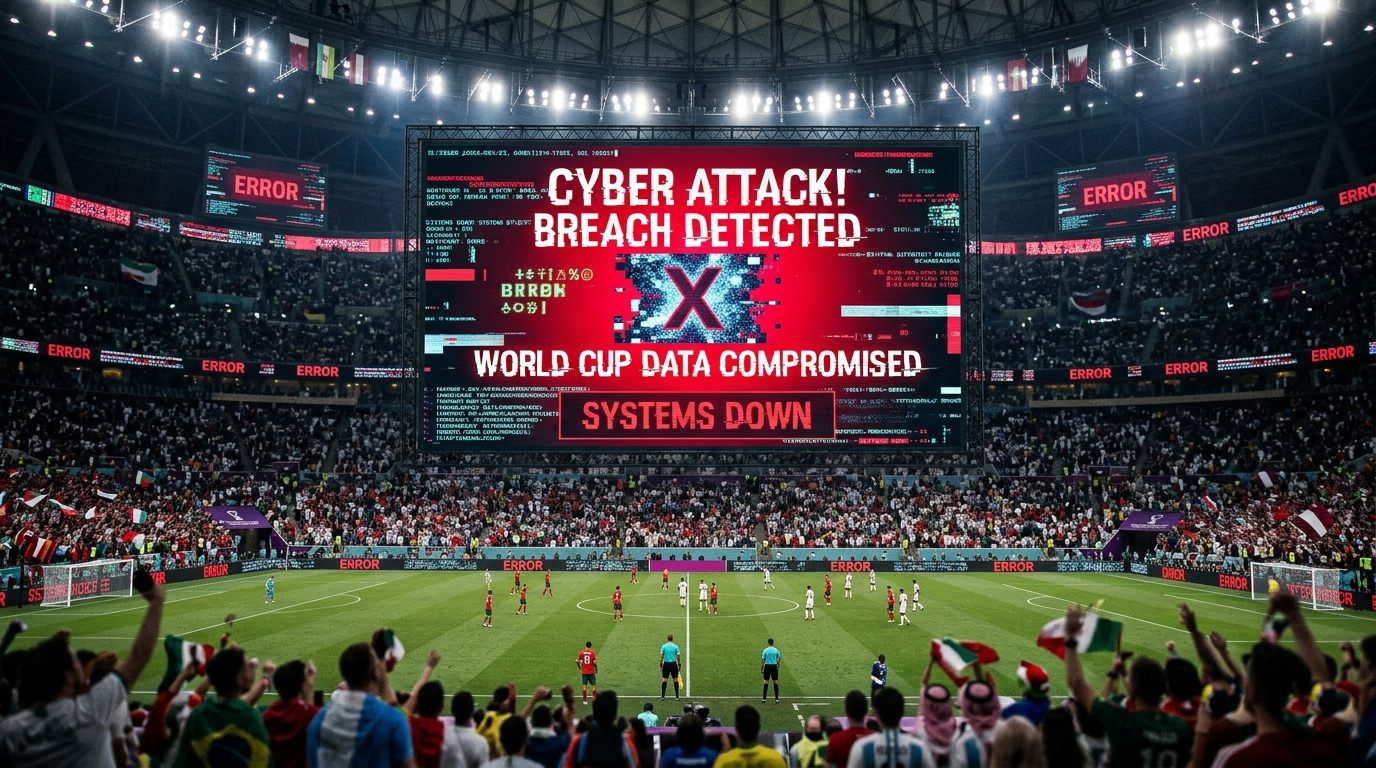
On June 18, 2026, cybersecurity firm Cofense Intelligence published findings on an active, highly sophisticated phishing campaign exploiting global excitement around the FIFA World Cup 2026. The malware it delivers is called Voidrift, and the way it reaches its victims is unlike most phishing attacks you’ve heard about before. Most phishing emails are generic. “Dear Customer, click here to claim your prize.” Easy to spot, easy to ignore. This one is different. Each email in this campaign is individually crafted. The attacker already knows your name, your company’s name, and has gone to the trouble of downloading your company’s actual logo and embedding it onto a fake World Cup t-shirt image inside the email. The message claims your employer has partnered with FIFA to offer exclusive merchandise to staff and all you have to do is click a link to claim yours.
The urgency is built in. The legitimacy is fabricated but convincing. And the emotional hook World Cup fever is perfectly timed. Once you click, Voidrift is delivered. The malware is engineered specifically to resist analysis and operate with an unusually low detection footprint, meaning it can sit on a system quietly, doing damage, without triggering alerts on most standard security tools. To make it even harder to catch, the malware payload is hosted on a legitimate domain so even URL-scanning tools see nothing suspicious.
Why This Attack Works So Well
To understand why this campaign is so dangerous, you have to look at it in three layers.
Layer 1: The Social Engineering
Cybercriminals have understood for years that human emotion is the most exploitable vulnerability in any security system. The World Cup is one of the most emotionally charged global events on the calendar, particularly in Africa, where football is not just a sport but a cultural identity. An email promising something World Cup-related, addressed to you personally, from an apparently legitimate source, bypasses a lot of the scepticism that good security training builds up. When excitement is high, guard is low.
Layer 2: It Bypassed Enterprise Email Defences
Here is where it gets technically alarming. This campaign was confirmed to have successfully bypassed three of the most widely deployed enterprise email security platforms in the world: Cisco IronPort, Microsoft ATP, and Abnormal Security. These are not budget tools; they are the solutions that large corporations, banks, and government contractors pay significant sums to deploy. They all failed to flag these emails.
This is a critical point for every IT and security professional reading this: the tools you are depending on as your primary line of defence were not enough. Perimeter controls, no matter how advanced, are not a complete security strategy.
Layer 3: The Malware Hides in Plain Sight
Even if the email gets through and the user clicks, a good endpoint security tool should catch the malware installation in theory. Voidrift is specifically engineered to defeat that assumption. It resists forensic analysis, maintains a low behavioural footprint, and because it is delivered from a legitimate domain, it does not trigger the network-level flags most security tools look for. The combination means infections could persist for extended periods before anyone notices something is wrong.
Three layers of sophistication, each one compounding the last. That is what makes this campaign a high-priority threat.
The African Angle: Why This Hits Close to Home
For African audiences, this story carries weight that goes beyond the global cybersecurity conversation. Football culture makes us a prime target. Across Cameroon, Nigeria, Senegal, Ghana, South Africa, and the rest of the continent, World Cup season drives genuine excitement. People are talking about it in offices, sharing updates on WhatsApp, following their national teams with passion. Threat actors know this. A World Cup lure targeting a company in Nairobi or Yaoundé will land in an inbox primed to receive it.
Corporate security infrastructure is patchy at best. The irony of this campaign is that the organisations with the best email defences those running Cisco IronPort and Microsoft ATP still got bypassed. Many African SMEs and mid-market businesses don’t run any enterprise-grade email gateway at all. A lure this convincing, against an organisation with no dedicated filtering, is almost guaranteed to succeed.
We lack the incident response capacity to catch what slips through. Voidrift’s low detection footprint is especially dangerous in environments where there is no dedicated security operations function watching for anomalous behaviour. In most Cameroonian businesses, and across much of Central and West Africa, security monitoring is either basic or nonexistent. By the time an infection is discovered, the damage may already be done: credentials stolen, data exfiltrated, systems compromised.
Growing connectivity means a growing attack surface. The rapid expansion of internet access across Africa through fibre rollouts, Starlink deployments, and mobile broadband growth is genuinely transformative. More businesses are getting online. More employees are using email. More systems are connected. This is progress. But it also means more entry points for campaigns exactly like this one. Digital inclusion without digital literacy is a vulnerability at scale.
Local brands are not immune to impersonation. This campaign used company logos to build credibility. Nothing is stopping a localised version of this attack from impersonating a Cameroonian telecoms company, a regional bank, or a government agency to target employees and clients across the continent. The technique is already proven.
What Organisations Should Do Right Now
Awareness is the first line of defence, but it has to translate into action. Here is what individuals and organisations across Africa should be taking seriously this World Cup season and beyond.
1. Do not rely on your email filter alone.
The Cofense findings make this non-negotiable. Three leading enterprise tools failed. Your email gateway is a necessary layer, but it is not sufficient. Complement it with user training, behavioural monitoring, and, if resources allow a human-reported threat intelligence system where employees can flag suspicious emails.
2. Train your team specifically around event-driven phishing.
Generic security awareness training is useful, but targeted training around active threats is better. Right now, every employee in your organisation should know that World Cup-themed emails offering prizes, gifts, or exclusive access are a live threat vector. This applies equally during election season, public holidays, major conferences, and global news events.
3. Verify before you click always.
Any email claiming your employer has a partnership with FIFA, UEFA, or any other major body should be verified through an official channel before any link is clicked. A 30-second WhatsApp message to HR or management is all it takes to break the chain of a successful phishing attack.
4. Implement basic email authentication standards.
For organisations managing their own email infrastructure, ensure DMARC, DKIM, and SPF records are correctly configured. These protocols make it significantly harder for attackers to successfully spoof your domain or send emails that appear to come from legitimate sources.
5. For tech companies and systems integrators: embed cybersecurity in every client conversation.
Those of us deploying smart systems, networking infrastructure, and connected devices across Africa have a responsibility that extends beyond the installation. Every Starlink setup, every smart home deployment, every office network we commission is a potential entry point if the human layer is not educated. Cybersecurity awareness should be part of every client handover, every system briefing, and every onboarding conversation.
The Bigger Picture
What this World Cup phishing campaign ultimately reveals is not a new threat; it is an evolved one. Attackers are no longer lazy. They are patient, resourceful, and increasingly surgical. They research their targets. They time their campaigns to coincide with moments of maximum distraction. They build infrastructure that legitimate security tools trust. And they deploy malware designed to stay invisible. The defences that worked five years ago are being outpaced.
For Africa, where digital transformation is accelerating fastest, and security infrastructure is still catching up, this gap is not an abstract concern. It is a present-tense vulnerability affecting businesses, institutions, and individuals right now. The World Cup is a celebration. It should not become a breach. Stay alert. Train your people. Question the email that seems too good to be true, even when it has your company’s logo on it.