












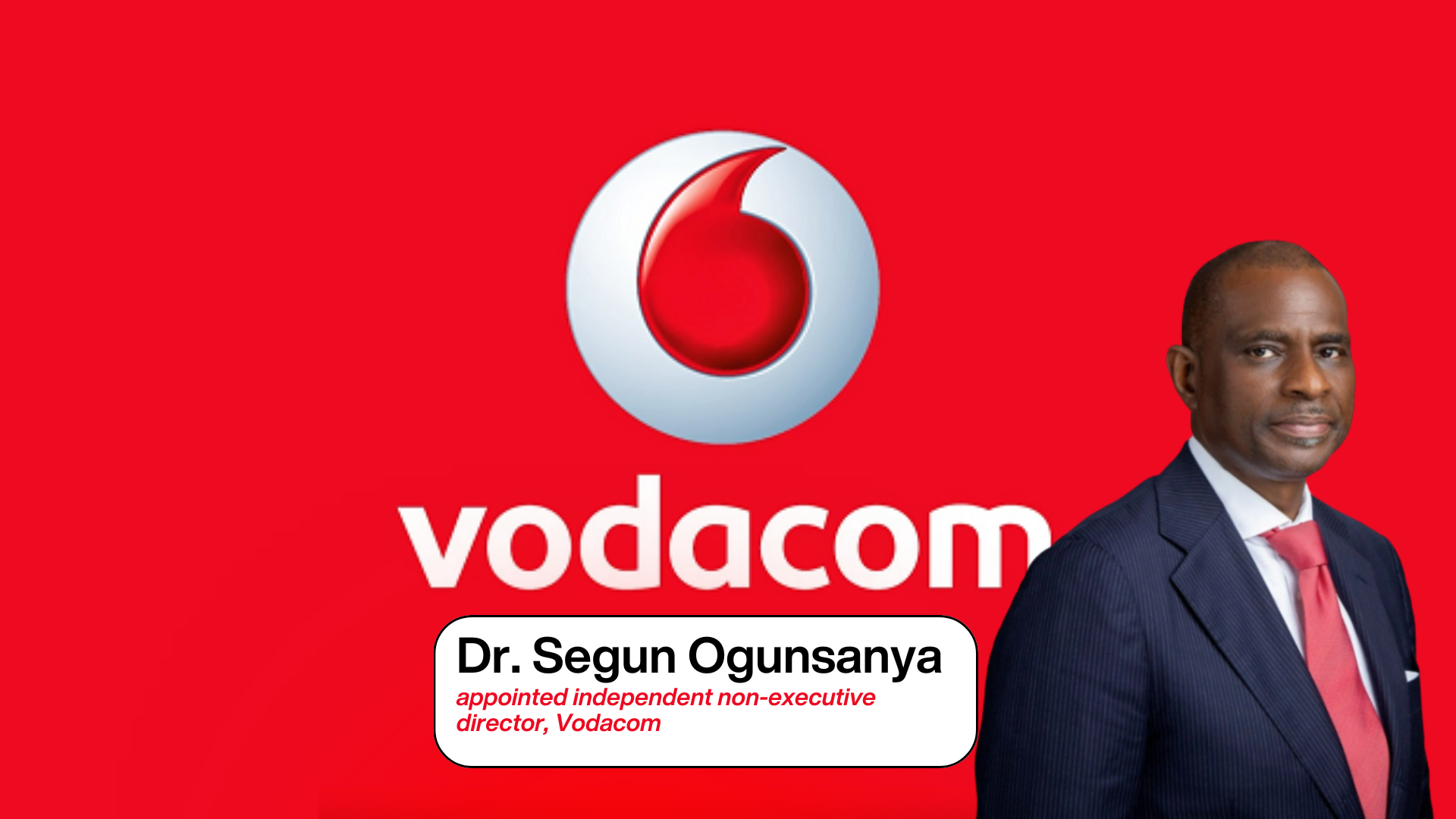









Imagine losing a market share war to a competitor for years, then hiring their general the moment he retires. That’s essentially what just happened in African telecom.
Vodacom Group has appointed Segun Ogunsanya, former Group CEO of Airtel Africa, as an independent non-executive director on its board, effective 9 October 2026. He replaces Phuthi Mahanyele-Dabengwa, who retires from the board on 8 October 2026 after joining in January 2019, where she chaired the Remuneration Committee.
Mr. Ogunsanya isn’t a stranger to the industry he’s now advising from the other side of the table. He led Airtel Africa as Group CEO and Managing Director until his retirement in June 2024, spending years going head-to-head with Vodacom across the same
His resume outside telecom is heavier than most board appointments get. He carries more than 35 years across finance, banking, FMCG, telecommunications and corporate governance, with stints at Nigerian Bottling Company, Coca-Cola Sabco in Kenya, Coca-Cola Bottling Company in Ghana, and Ecobank Transnational, where he oversaw retail operations across 28 African countries. He’s also an electrical and electronics engineering graduate of the University of Ife (now Obafemi Awolowo University), chairs Nigeria’s Sovereign Investment Authority, and sits on the Nigeria Economic Summit Group board.
This is bigger than one seat because Vodacom used the appointment to reshuffle the entire top of its governance structure. Chairman Saki Macozoma, on the board since July 2017, will retire at the company’s AGM on 20 July 2027 under Vodacom’s self-imposed 10-year board tenure policy, with lead independent director Khumo Shuenyane set to succeed him. Clive Thomson takes over as Remuneration Committee chair from October while staying on as Audit, Risk and Compliance chair.
Vodacom also confirmed the paperwork side is clean: the board completed a fit and proper assessment under JSE Listings Requirements and reported no adverse findings in Ogunsanya’s director declaration.
But Why does this actually matters? Strip away the corporate-governance language and here’s what’s really happening: Vodacom and Airtel Africa are two of the three biggest telecom operators fighting for mobile money, data, and subscriber share across Sub-Saharan Africa Kenya, Nigeria, Tanzania, DRC, and beyond. These aren’t companies that coexist peacefully. They’re direct competitors in mobile money rails, data pricing wars, and spectrum battles in nearly every major market they both touch.
Putting a former rival CEO on your board isn’t just picking up a talented operator. It’s picking up institutional knowledge of how the other side thinks, prices, and expands. Ogunsanya spent years inside Airtel Africa’s boardroom watching how it made expansion decisions across the continent. That’s not something you can buy from a headhunter.
There’s also a market-confidence signal here. Vodacom is JSE-listed, and board composition changes get read closely by institutional investors. A high-profile, continent-credible appointment like this paired with a clean succession plan for the chairmanship reads as a company signaling stability at a moment when several African telecom operators are under real earnings pressure from currency volatility and infrastructure costs.
However, A couple of things in this announcement deserve a raised eyebrow rather than a nod. First, the phrase Vodacom used that there were “no positive statements to report regarding the integrity information” in Ogunsanya’s director declaration is oddly worded legal boilerplate that effectively means “nothing bad turned up,” but it reads clumsily enough that it’s worth Vodacom clarifying in plain English, especially given how closely JSE-listed disclosures get scrutinized.
Second, nobody in this announcement is addressing the obvious governance question directly: what are the conflict-of-interest guardrails for a former direct competitor’s CEO sitting on your board, especially one who spent years in confidential strategic discussions at Airtel Africa? Non-executive directors typically recuse from matters with direct conflicts, but this announcement doesn’t spell out what that looks like in practice for someone with this specific competitive history. That’s a gap worth watching, not dismissing.
This appointment is a smart, calculated move by Vodacom, not just a resume-collecting exercise. Bringing in a former rival CEO signals Vodacom wants competitive intelligence and continental credibility in the boardroom, not just another finance-and-governance name. If Airtel Africa doesn’t respond with a comparably sharp board move of its own within the next year, it’ll be a tell that Vodacom just won a quiet round in the talent war between Africa’s biggest telecom rivals.