






















Picture a warehouse floor in Douala, a manufacturing line in Johannesburg, or a logistics hub in Nairobi, ten years from now. Alongside the human workers, moving through the same aisles, lifting the same loads, and handing off the same packages, are humanoid robots. Not behind cages. Not in restricted zones. Working beside people, responding to their movements, making real-time decisions about when to slow down, step aside, or stop entirely. That future is no longer science fiction. As of today, it has a safety system.
On June 22, 2026, NVIDIA announced Halos for Robotics, which the company describes as the industry’s first full-stack, comprehensive safety architecture for robots and physical AI. It is the infrastructure layer that makes the humanoid co-worker not just possible, but certifiably safe. And it signals something far bigger than a product launch: the global industrial economy is crossing a threshold, and Africa needs to be paying close attention to which side of it we land on.
What did Nvidia just build? To understand why Halos for Robotics is significant, you first need to understand the problem it solves. The safety challenge with humanoids is fundamentally different from traditional industrial robots. Existing approaches to robot safety tend to freeze or slow machines the moment a human enters their vicinity a blunt solution that cuts into productivity and makes genuinely collaborative work, such as passing tools or sharing a physical load, essentially impossible.
In other words: the robots we have had until now are either productive or safe or rarely both. The moment a person gets close, the machine stops. That is fine for a robot behind a welding cage. It is completely impractical for a humanoid designed to actually work with people.
A humanoid requires real-time reasoning about what it can and cannot touch or exert force on. As Amit Goel, a senior director of product management at NVIDIA, put it: “If you think about safety in the context of a traditional robot, it is basically you need to put it in a cage or you need to have sensors which can detect there’s an obstacle and the robot comes to a stop. But that is not enough for a humanoid robot.”
Halos for Robotics is NVIDIA’s answer to that problem. It is a unified safety architecture connecting AI compute, system software, sensor data, safety applications, and inspection for robotic systems with safety built into every layer of the stack. Yahoo!
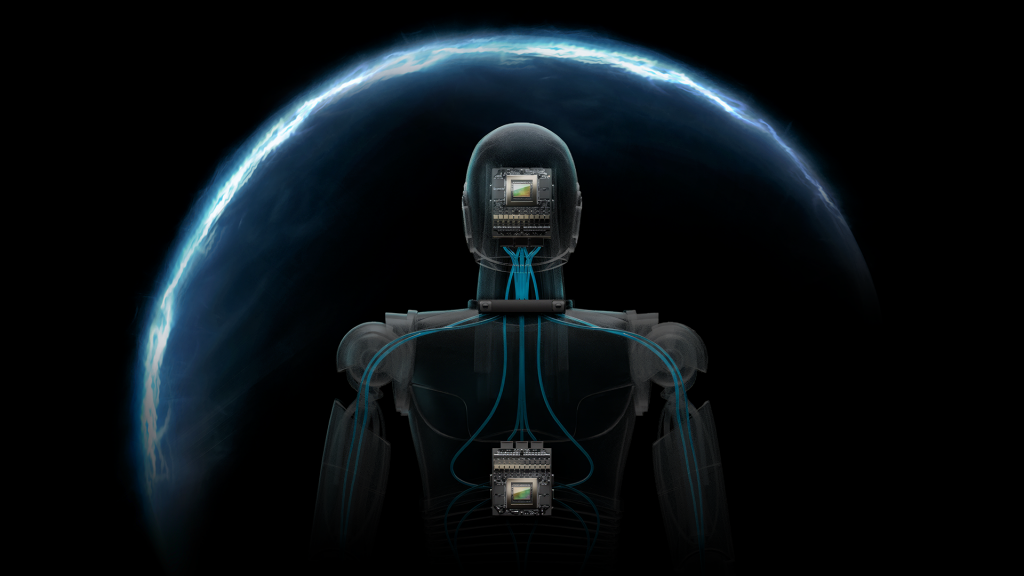
The system has three core components. The hardware layer is built on NVIDIA IGX Thor an industrial-grade AI computing platform with safety capabilities built in, paired with the Holoscan Sensor Bridge for real-time sensor connectivity. On top of that sits Halos OS, the safety software layer that manages safety-related operating functions and runs pluggable safety applications. And sitting above all of it is the NVIDIA Halos AI Systems Inspection Lab an ANSI-accredited facility where robot makers can complete rigorous safety testing before seeking third-party certification from bodies like TÜV Rheinland, TÜV SÜD, and UL Solutions.
The technology behind Halos draws on more than 18,600 engineering years of autonomous vehicle safety development. This is not a hastily assembled product. It is the accumulated knowledge of building systems that must make split-second safety decisions in dynamic, unpredictable real-world environments now applied to humanoid robots.
One particularly compelling innovation is what NVIDIA calls the Outside-In Safety Blueprint. This component feeds data from external cameras and AI agents into the robot’s decision-making loop, allowing its behaviour to be adjusted dynamically based on conditions in the surrounding environment. A self-driving forklift could, for instance, evaluate conditions on the other side of a blind corner and adjust its speed accordingly. The robot is not just aware of what it can see directly it has eyes throughout the entire facility.
Now Who Is Already Using It? Agility Robotics is the first company to incorporate elements of Halos for Robotics into its proprietary safety system. Its humanoid robot, Digit, is already deployed in factories, warehouses, and logistics operations for customers including Amazon, GXO, Schaeffler, and Toyota Motor Manufacturing Canada. NVIDIA Newsroom
Agility is integrating NVIDIA IGX Thor and Halos Core into Digit’s proprietary human detection system, which is designed for industrial work in logistics, manufacturing, and warehouse operations. Together, Agility and NVIDIA will use the Halos Inspection Lab to ensure Digit’s safety-related software, AI components, and cybersecurity protections meet standards such as IEC 61508, ISO 13849, and ISO/IEC TR 5469 before final third-party certification.
The ecosystem around Halos is already substantial. The NVIDIA Halos AI Systems Inspection Lab includes more than 40 companies across manufacturers, certification bodies, and safety vendors working to move safe physical AI systems from design to real-world deployment. Other industrial robotics companies, including FORT Robotics, Inventec, and KION Group, are building safety agents using the NVIDIA Halos Outside-In Safety Blueprint. The Robot Report
This is not a pilot programme or a proof of concept. The infrastructure for safe, certified, human-collaborative humanoid robots is being assembled right now, at scale, by some of the most consequential companies in global manufacturing.
The announcement of Halos for Robotics is significant for reasons that extend well beyond product specifications.
It establishes the safety standard that the entire industry will follow. When NVIDIA the world’s most valuable semiconductor company defines a safety framework and gets it accredited by ANSI and accepted by the world’s leading certification bodies, that framework becomes the de facto global standard. Every company that wants to deploy humanoid robots in industrial settings will eventually have to engage with this architecture, or an equivalent that meets the same bar. The standard is being written today.
It removes the last major barrier to humanoid robots at scale. The technology to build humanoids has existed for several years. What has held back mass deployment is the inability to certify their safety in environments shared with humans. According to Barclays, by 2035, humanoid robotics could generate $200 billion in annual revenue. That number becomes credible only once safety is solved. Halos is the piece that unlocks the market.
It accelerates the timeline for human-robot collaboration in real workplaces. This year, robots-as-a-service agreements brought humanoids such as Agility’s Digit out of pilots and into facilities such as Toyota Motor Manufacturing Canada’s Woodstock facility in Ontario, putting them in manufacturing supply chains. The transition from “interesting experiment” to “production infrastructure” is already happening. Halos accelerates it further.
It raises profound questions about the future of work. Every major advance in robotics capability prompts the same question: what happens to the people currently doing those jobs? With humanoid robots now able to safely share workspaces with humans, the scope of tasks they can perform expands dramatically and so does the urgency of planning for the workforce transitions that follow.
From Africa’s angle, the relationship with robotics and industrial automation is not yet defined. That ambiguity is both a risk and an opportunity. The manufacturing moment is arriving. Across the continent, governments and development finance institutions are investing heavily in industrialisation. Ethiopia’s textile sector, Kenya’s light manufacturing, South Africa’s automotive supply chain, Cameroon’s agro-industrial base these are all arenas where automation will become a competitive necessity within the next decade. The question is not whether robots will arrive in African factories. It is who owns them, who controls the standards they operate under, and whether the workforce is prepared.
The safety framework conversation is happening without us. The standards being embedded into Halos for Robotics IEC 61508, ISO 13849, ISO/IEC TR 5469 are being shaped by regulators, certification bodies, and technology companies predominantly in North America, Europe, and East Asia. African governments, standards bodies, and industry associations are largely absent from these conversations. Yet these are the frameworks that will govern every humanoid robot deployed on African soil, in African factories, working alongside African workers
This is both a technology story and a skills story. The deployment of systems like Halos for Robotics requires engineers who understand AI compute architectures, safety software stacks, sensor integration, and certification workflows. Those skills do not exist at scale in Africa yet. Building that capacity through universities, technical colleges, and professional development is not optional. It is the difference between being an importer of robot technology and being a participant in the ecosystem that builds it.
There is a leapfrogging opportunity. Africa has a history of bypassing legacy infrastructure in favour of newer technologies mobile money being the defining example.
A continent that has not yet built out the traditional factory automation infrastructure of the 20th century is in a position to deploy 21st-century human-robot collaborative systems from the start. That requires investment, policy intent, and technical readiness, but the window exists. The workforce displacement question demands proactive governance. Safe human detection, avoidance, slowing and freezing when necessary to prevent actuators that move with force from inflicting injury these are the safety capabilities now being standardised. They make humanoid robots safe to deploy in warehouses and factories. They also make it technically viable to replace a much wider range of manual labour roles than was previously possible. For African economies where manufacturing and logistics employ significant portions of the formal workforce, the policy response to this transition needs to begin now, not when the first humanoids arrive at the dock.
What Leaders in Technology, Business, and Government Should Do? For technology professionals: Understand what Halos for Robotics represents architecturally. The convergence of AI compute, safety software, sensor fusion, and certification frameworks is the pattern that will define physical AI deployment globally. Familiarity with these systems is a career differentiator.
For manufacturers and logistics operators: If you are building or expanding facilities in Africa, the infrastructure decisions you make today will determine your automation readiness in five years. Designing with human-robot collaboration in mind from the outset is cheaper than retrofitting later.
For educators and training institutions: The skills required to deploy, maintain, and manage systems like Halos for Robotics AI systems engineering, safety certification, sensor integration, robotics programming are in short supply globally and nearly absent on the continent. Curriculum development in this space is urgent.
For policymakers and regulators: Africa needs representation in the international standards conversations that are defining how humanoid robots will be governed. Engaging with bodies like ISO, IEC, and ANSI and building domestic technical capacity to participate meaningfully is a strategic priority. For the rest of us: Follow this space. The humanoid robot working beside a human on a factory floor is no longer a 10-year prediction. It is a 3-year projection. The decisions being made right now about safety standards, certification frameworks, deployment models, and workforce transitions will shape the industrial economy that Africa enters as these technologies mature.
NVIDIA’s Halos for Robotics announcement is, on its surface, a product launch. But what it actually represents is a civilisational infrastructure decision: the moment when the global industrial economy formally committed to deploying humanoid robots in human workspaces, with a safety architecture to match. NVIDIA’s Halos software will be the basis of computers that give robots a much better awareness of what’s happening around them, allowing humanoids to enter the workplace and truly interact with people, even making physical contact if necessary.
The age of the humanoid co-worker is not coming. It is here. And the standards, systems, and safety frameworks being established this year will govern how that transition unfolds across every economy on earth, including Africa’s. The question is whether Africa will shape that transition, or simply receive it.